


PARFIX K880 PU
Two-component fast-curing PU adhesive for interior and exterior installation of resilient floor coverings and compact flooring
Product ID: 61208154 - PARFIX K880 PUPARFIX K880 PU 2K is a two-component fast-curing polyurethane adhesive with high elasticity and toughness suitable for bonding in interior and exterior environments:
• PVC flooring in rolls or tiles
• Compact Floors (Egger Aqua +,...)
• rubber flooring in tiles or sheets
• rubber sports floors
• vinyl flooring and textile flooring
• polycarbonate coverings
• underfloor heating systems
• artificial grass, outdoor and sports surfaces
• shrinkage-free
• flexible and strong at the same time
• high resistance to heat and cold
After full curing, PARFIX K880 PU 2K becomes resistant to heat, water and weather conditions.
■ FAST CURING (12–24 H)
■ VERY HIGH STRENGTH AND ELASTICITY
■ SUITABLE FOR DEMANDING AND EXTERIOR APPLICATIONS
Mixing ratio | 7.33 : 1 |
Color | Ivory |
Recommended application temperature | +10°C to +25°C |
Application (for PVC, rubber, vinyl and textile floor coverings) | Using B1 notched trowel |
Application (for compact flooring) | Using B11 or B15 notched trowel |
Open time | 70–80 min (1) |
Walkable after | 24 h (1) |
Seam welding after | 12–24 h (1) |
Final strength after | 72 h (1) |
Consumption (for PVC, rubber, vinyl and textile floor coverings) | 300–400 g/m² depending on the substrate |
Consumption (for compact flooring) | B11 notched trowel: 1000–1200 g/m²; B15 notched trowel: 1200–1400 g/m² |
Storage stability | 1 year (2) |
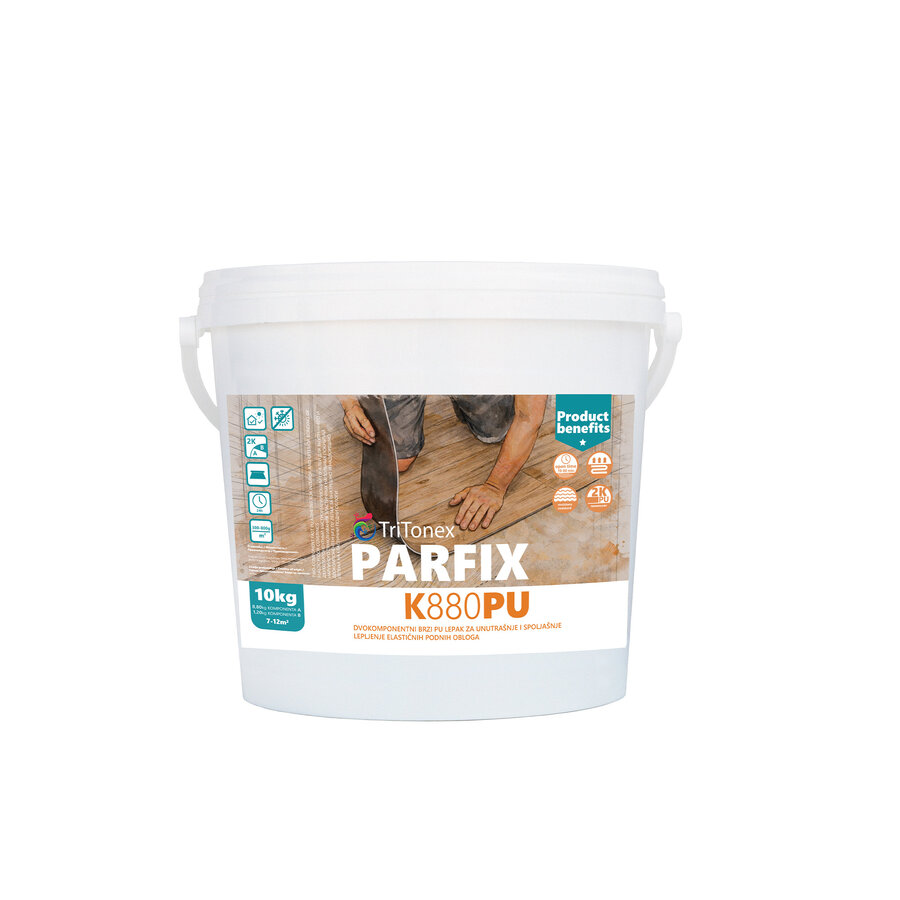
Packaging A+B | 10 kg (8.80 + 1.20) |
(1) at 20°C and 65% relative humidity
(2) in original sealed containers at temperatures between +10°C and +25°C
Tool cleaning: solvent based on acetone
Substrate: dry, clean, dust-free, not excessively rough.
Substrate moisture:
2.0% max. for cement-based substrates;
1.7% max. for substrates with underfloor heating;
0.5% max. for anhydrite substrates;
0.2% max. for anhydrite substrates with underfloor heating.
Method of use
Before use, mix the product until a homogeneous mixture is obtained. It is important to ensure that there is no permanent capillary moisture coming from the substrate. Dry but loose substrates must first be primed with suitable primers: PARFIX PU PRIMER or PARFIX PU RAPID PRIMER (see technical data sheets). Cement substrates with high residual moisture should be coated with PARFIX 4.5 BLOCK (see technical data sheet), then broadcast with quartz sand and leveled using suitable leveling compounds. Poorly absorbent or non-absorbent substrates must be cleaned from dust, sand, adhesive residues and wax. If the substrate needs additional leveling and smoothing, use appropriate self-leveling compounds which must be lightly sanded and dust removed after drying before bonding.
Installation on suitable substrates
PARFIX K880 PU 2K must not be diluted. After thoroughly mixing Components A and B, apply the adhesive evenly to the substrate. For PVC, rubber, vinyl and textile floor coverings, apply the adhesive using a B1 notched trowel. After laying the flooring, roll the entire surface evenly with a suitable roller to ensure full contact between the covering and the adhesive and to remove any trapped air bubbles. For compact floor coverings, apply the adhesive using a B11 notched trowel, or a B15 notched trowel on substrates with greater unevenness. Lay the compact flooring into the fresh adhesive bed and ensure full contact over the entire surface. Fresh residues of PARFIX K880 PU adhesive must be removed immediately using PARFIX PU Cleaner. Cured adhesive can only be removed mechanically.
Floor coverings to be installed should always be removed from their packaging several hours before installation to release tension and stabilize them to indoor climate conditions. If the floor is not perfectly flat, place weights (such as sandbags, adhesive cans, etc.) on uneven areas, joints and roll ends after installation until PARFIX K880 PU 2K has cured (12–24 hours).
Rubber flooring may contain plasticizers and waxes on the backing due to the manufacturing process, therefore it is recommended to clean the back side of the covering with an acetone-based solvent.